A commercial cleaning scope should reflect how a property actually operates. Square footage matters, but it is only one part of the equation. Traffic, access, cleaning windows, restroom use, floor type, staffing, waste handling, tenant activity, and required frequency all influence what a dependable service plan should include.
That is why two properties of similar size can require very different levels of care. A quiet professional office with controlled access is not maintained the same way as a multi-tenant building with busy common areas, high restroom usage, frequent deliveries, and daily waste movement. The right scope begins with the operation—not with a one-size-fits-all checklist.
Start with how the property is actually used
Before frequency or pricing can be considered responsibly, the property needs to be understood. Occupant volume, visitor traffic, business hours, tenant mix, access restrictions, sensitive areas, and the times when cleaning can take place all affect the service design.
A building that remains active into the evening may require a different cleaning window than an office that closes earlier. A property with public-facing areas may place greater emphasis on presentation throughout the day. A managed building may also require coordination with maintenance teams, property managers, security, or tenant schedules.
Office and common areas establish the everyday impression
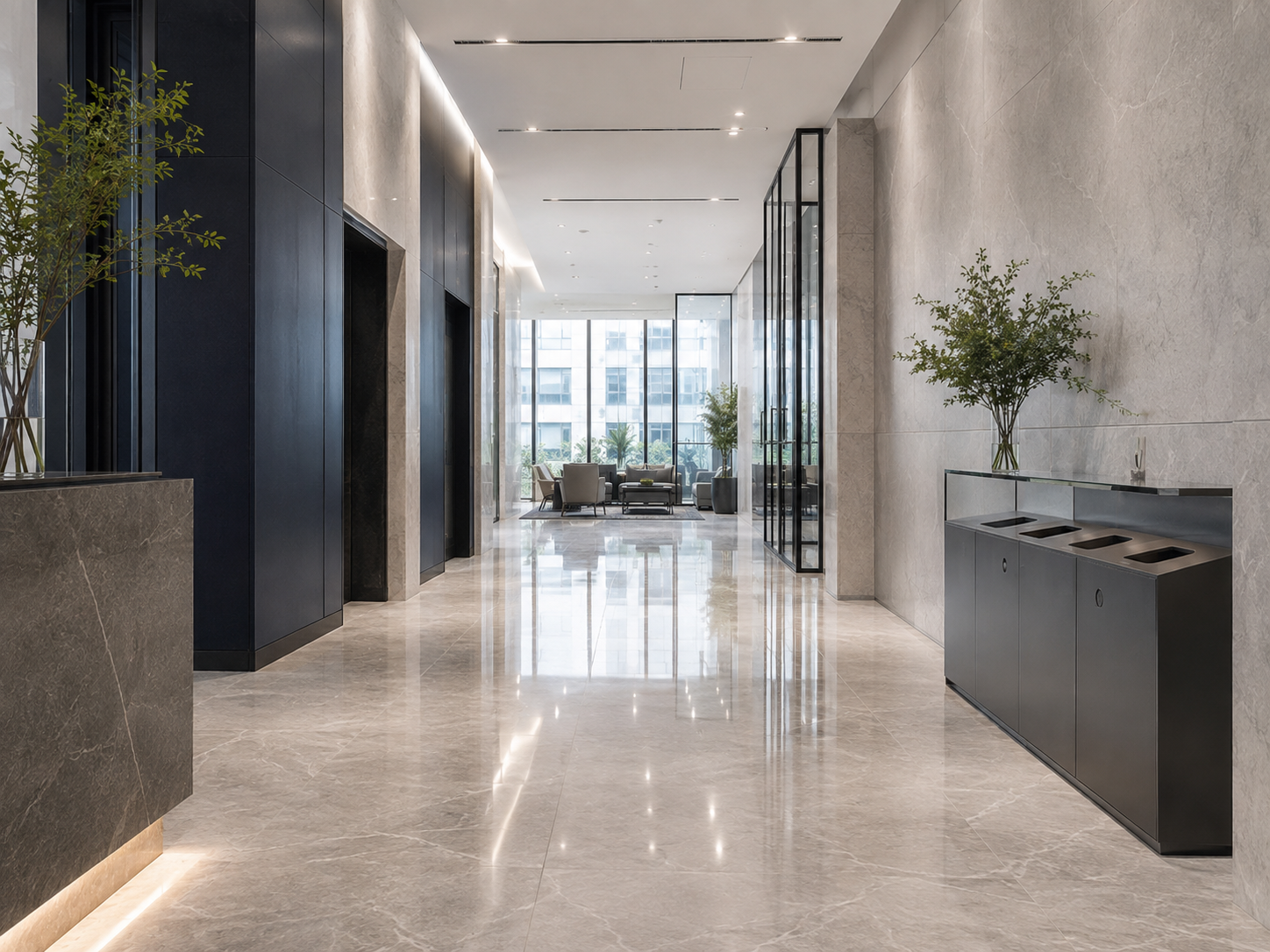
Entrances, reception areas, corridors, conference rooms, shared workspaces, elevators, stairwells, and other common areas are often the first places where the condition of a commercial property becomes visible. These spaces collect fingerprints, tracked-in debris, dust, paper waste, and the signs of normal daily use.

The service scope should identify which common areas carry the most traffic and which areas have the highest presentation priority. This allows attention to follow the way the property is used instead of treating every room as if it experiences identical conditions.
Restroom usage often determines the cleaning frequency of the facility
Restrooms are one of the clearest indicators of whether a commercial cleaning schedule is frequent enough. Occupancy, visitor volume, fixture count, supply usage, ventilation, and the length of the operating day all affect how quickly conditions change.
OSHA requires employers to provide sanitary and immediately available restroom facilities for workers. That does not define a universal visit schedule, but it does reinforce why restroom condition cannot be treated casually in a commercial environment. OSHA: Restrooms and Sanitation Requirements — Overview
For general industry, OSHA's sanitation standard also addresses issues such as cleanliness and waste disposal. That makes restroom and waste-area planning part of the broader operational standard of the facility, not just a cosmetic preference. OSHA Standard 29 CFR 1910.141 — Sanitation
Break rooms and kitchens require their own level of control
Shared kitchens and break rooms combine food residue, sinks, appliance exteriors, tables, touch points, trash, recycling, and high employee traffic. They can change condition quickly even when the rest of an office remains relatively composed.
The commercial scope should clarify what is included during each visit, what remains the responsibility of occupants, and whether higher-frequency attention is needed in heavily used areas. Clear expectations prevent a recurring service from becoming an undefined collection of tasks.
Floor care should follow material, traffic, and season
Commercial floors are affected by far more than visible dirt. Surface material, finish, traffic lanes, entry systems, weather, moisture, grit, salt, and the movement of equipment all influence how a floor should be maintained.

In New England, seasonal conditions matter. Winter salt and sand can significantly change the workload at entrances and high-traffic pathways. A strong recurring plan anticipates those conditions instead of waiting until the floor has visibly declined.
The Centers for Disease Control and Prevention notes that facilities should clean high-touch surfaces regularly and other surfaces when visibly dirty, with disinfection used when appropriate. That principle supports a scope built around real use patterns, surface conditions, and risk—not assumptions. CDC: When and How to Clean and Disinfect a Facility
Trash removal and waste handling need operational clarity
Commercial waste can involve desk-side bins, centralized trash, recycling, break-room waste, building collection points, and exterior dumpsters. The cleaning company needs to know where waste is generated, where it is consolidated, when it can be moved, and what the building expects after removal.
For some properties, dumpster changeover or associated waste-area support is also part of the service relationship. These responsibilities should be defined at the beginning so they are planned, scheduled, and staffed correctly.
Turnover support is different from routine recurring cleaning
Tenant departures, office transitions, management changes, and space preparation create work that falls outside ordinary maintenance. Turnover support can require a more concentrated reset of the space before new occupants, leasing activity, inspections, or another operational phase begins.
A recurring commercial relationship works best when these project-level needs are identified separately. That protects the consistency of the regular schedule while giving the property a clear path for larger transitions.
Frequency should be based on demand—not convention
There is no universal answer to whether a commercial property should be cleaned daily, several times per week, weekly, or on another schedule. Frequency should reflect how quickly each part of the building moves away from the desired standard.
In some facilities, restrooms and waste may drive frequency. In others, entrances, common areas, kitchens, or tenant expectations may be the determining factor. The objective is to create a schedule that maintains the property consistently without under-servicing critical areas or overbuilding the scope where it is unnecessary.
What Englair reviews before preparing a commercial service plan
Our commercial planning process begins with the property itself. We review the actual operating environment, priority areas, access requirements, expected presentation level, frequency needs, and any responsibilities that require coordination with property management or facility teams.
- Office & common areas — presentation, touch points, shared spaces, and traffic patterns.
- Restrooms — usage, fixtures, supplies, and the frequency required to maintain condition.
- Break rooms & kitchens — shared-use surfaces, waste, sinks, and appliance exteriors.
- Floor care — material, traffic, entry conditions, and seasonal impact.
- Trash removal — collection points, recycling, movement, and building procedures.
- Turnover support — preparation between tenants, occupants, or operational phases.
- Dumpster changeover — when the property requires defined waste-area support.
- Custom recurring scope — a service plan built around the facility rather than a generic package.
Product selection should also support the standard
The Environmental Protection Agency's Safer Choice program helps purchasers identify cleaning products that perform while using ingredients considered safer for human health and the environment. That does not replace on-site judgment, but it is a useful benchmark when building a responsible service approach for occupied spaces. U.S. EPA: Safer Choice
For organizations that formalize custodial procurement, the EPA also publishes model contract language for custodial products and services, including floor-care considerations and recognized environmental standards. It is a useful example of how a commercial scope can go beyond task lists and define product and performance expectations. U.S. EPA: Custodial Model Contract Language
A commercial cleaning relationship should become more predictable over time
The strongest recurring service is not one that constantly improvises. It is one that becomes increasingly clear: the team understands the building, the property understands the scope, priorities are known, access is dependable, and communication is structured.
That consistency is what allows cleaning to become part of the operation rather than another problem for a property manager to manage.
For commercial properties in New Hampshire and select New England markets, Englair prepares recurring cleaning scopes around the actual needs of the property—from offices and common areas to restrooms, floor care, waste handling, turnover support, and customized service frequency.
Authoritative references
OSHARestrooms and Sanitation Requirements — Overview OSHA29 CFR 1910.141 — Sanitation CDCWhen and How to Clean and Disinfect a Facility U.S. EPASafer Choice U.S. EPACustodial Model Contract Language